

Geohuman: People, Place, and Power
Issue: Vol. 1 No. 2 (2026): GeoHuman: People, Place, and Power
Views
-
Downloads
Articles
Open Access
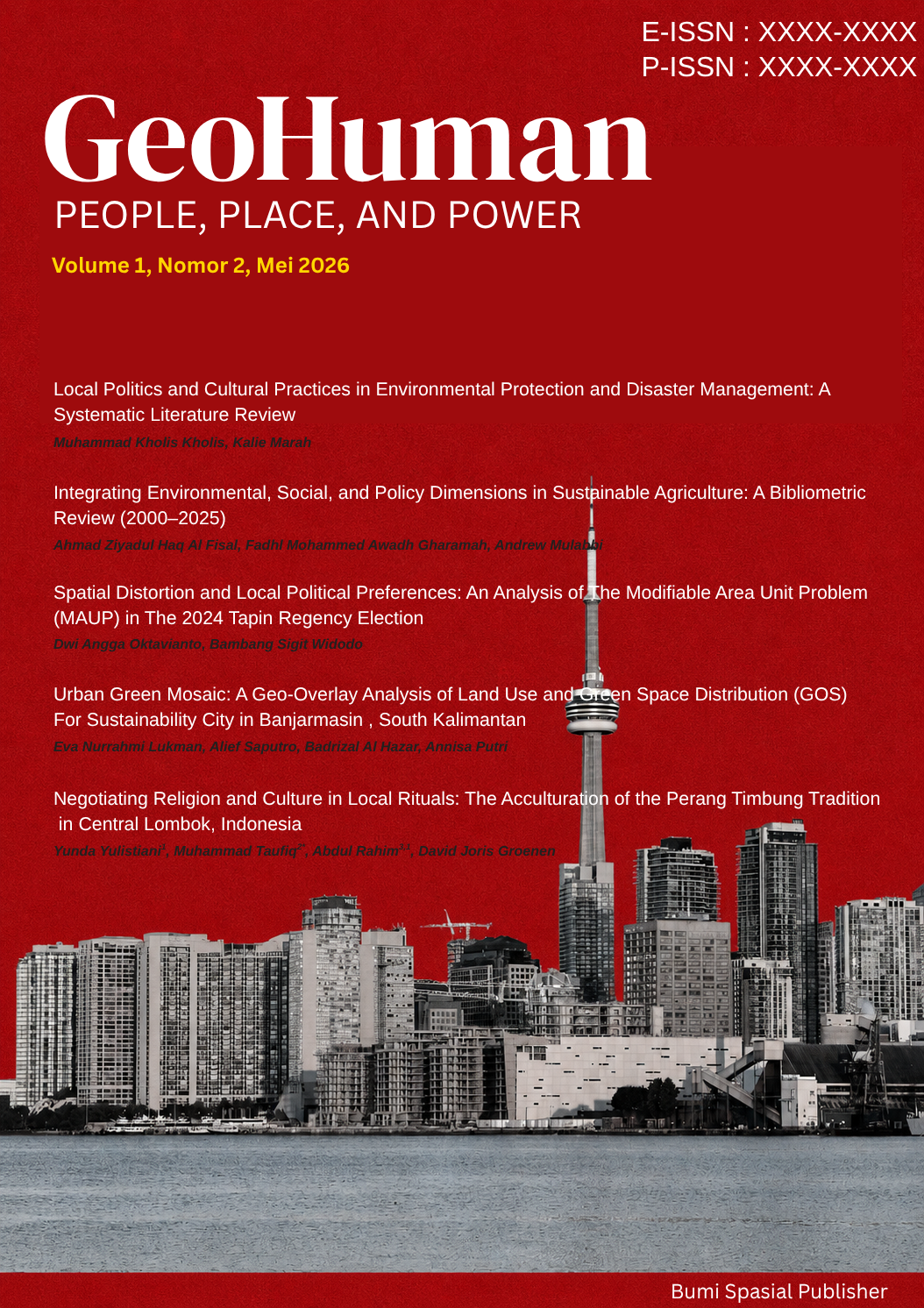
Spatial Distortion and Local Political Preferences: An Analysis of the Modifiable Area Unit Problem (MAUP) in the 2024 Tapin Regency Election
Dwi Angga Oktavianto
Bambang Sigit Widodo
Sanwit Iabchoon
Pages: 33-44
|
Published: 2026-05-06
|
Section:
Articles
- Agnew, J. (2018). Revisiting the territorial trap in political geography. Geopolitics, 23(1), 1–15. https://doi.org/10.1080/14650045.2016.1251905
- Anselin, L. (2010). Thirty years of spatial econometrics. Papers in Regional Science, 89(1), 3–25. https://doi.org/10.1111/j.1435-5957.2010.00279.x
- Aspinall, E., & Berenschot, W. (2019). Democracy for sale: Elections, clientelism, and the state in Indonesia. Journal of Democracy, 30(3), 34–48. https://doi.org/10.1353/jod.2019.0034
- Badan Pusat Statistik. (2000). Sensus Penduduk Tahun 2000: Data kependudukan menurut suku bangsa Kabupaten Tapin. Jakarta: Badan Pusat Statistik.
- Cho, W. K. T., & Gimpel, J. G. (2012). Geographic information systems and political analysis. Annual Review of Political Science, 15, 443–460. https://doi.org/10.1146/annurev-polisci-032710-104818
- Dark, S. J., & Bram, D. (2007). The modifiable areal unit problem in physical geography. Progress in Physical Geography, 31(5), 471–479. https://doi.org/10.1177/0309133307083294
- Fossati, D., Aspinall, E., Muhtadi, B., & Warburton, E. (2020). Ideological representation in clientelistic democracies: The Indonesian case. World Politics, 72(4), 623–659. https://doi.org/10.1017/S0043887120000123
- Fotheringham, A. S., & Wong, D. W. S. (1991). The modifiable areal unit problem in multivariate statistical analysis. Environment and Planning A, 23(7), 1025–1044. https://doi.org/10.1068/a231025
- Gimpel, J. G., Lay, J. C., & Schuknecht, J. E. (2018). Cultivating the grass roots: Geographic and social context in political participation. Political Geography, 62, 1–12. https://doi.org/10.1016/j.polgeo.2017.10.003
- Huckfeldt, R., & Sprague, J. (1995). Political disagreement in social networks: The dynamics of political learning. American Political Science Review, 89(1), 1–12. https://doi.org/10.2307/2083070
- Johnston, R., Jones, K., & Manley, D. (2020). The geography of voting revisited: New models of electoral geography. Progress in Human Geography, 44(4), 737–756. https://doi.org/10.1177/0309132519850840
- Lee, D. W., Rogers, M., & Soifer, H. D. (2025). The modifiable areal unit problem in political science. Political Analysis, 1–13. https://doi.org/10.1017/pan.2025.2
- Lee, S., Chun, Y., & Griffith, D. A. (2016). Exploring the impacts of the modifiable areal unit problem on spatial analysis. International Journal of Geographical Information Science, 30(11), 2157–2175. https://doi.org/10.1080/13658816.2016.1151217
- Manley, D., Flowerdew, R., & Steel, D. (2019). Scales, levels and processes: Studying spatial influences on electoral behavior. Geographical Analysis, 51(1), 1–16. https://doi.org/10.1111/gean.12175
- Rodden, J. (2019). Political geography and the urban–rural divide. Annual Review of Political Science, 22, 1–19. https://doi.org/10.1146/annurev-polisci-050317-070345
- Sinclair, B. (2012). The social citizen: Peer networks and political behavior. American Journal of Political Science, 56(1), 1–18. https://doi.org/10.1111/j.1540-5907.2011.00544.x
- Xu, Y., Chen, Y., & Li, Z. (2021). Revisiting MAUP effects in spatial electoral analysis. Environment and Planning B: Urban Analytics and City Science, 48(6), 1562–1578. https://doi.org/10.1177/2399808320941205
- Zhang, X., Burkhanova, D., Yang, Y., & Tian, J. (2025). Political participation and grassroots governance: A social work perspective based on CGSS 2021 data. PLoS ONE, 20(12), e0337520. https://doi.org/10.1371/journal.pone.0337520
How to Cite
Spatial Distortion and Local Political Preferences: An Analysis of the Modifiable Area Unit Problem (MAUP) in the 2024 Tapin Regency Election. (2026). Geohuman: People, Place, and Power, 1(2), 33-44. https://doi.org/10.69877/geohuman.v1i2.11
Similar Articles
- Muhammad Kholis Kholis, Kalie Marah, Local Politics and Cultural Practices in Environmental Protection and Disaster Management: A Systematic Literature Review , Geohuman: People, Place, and Power: Vol. 1 No. 2 (2026): GeoHuman: People, Place, and Power
- Eva Nurrahmi Lukman, Alief Saputro, Badrizal Al Hazar, Annisa Putri, Urban Green Mosaic: A Geo-Overlay Analysis of Land Use and Green Space Distribution (GOS) For Sustainability City in Banjarmasin, South Kalimantan , Geohuman: People, Place, and Power: Vol. 1 No. 2 (2026): GeoHuman: People, Place, and Power
- M Fikro Habibullah, Akbar Abdurrahman Mahfudz, Ali Muqsit, Eko Nofridiansyah, Ana Ariasari, Mapping Fishing Locations Based on Fishermen's Local Ecological Knowledge in Kahyapu Village, Enggano Island , Geohuman: People, Place, and Power: Vol. 1 No. 3 (2026): Vol. 1 No. 3 (2026): Geohuman: People, Place, and Power
- Yunda Yulistiani, Muhammad Taufiq, Abdul Rahim, David Joris Groenen, Negotiating Religion and Culture in the Perang Timbung Tradition on Transitional Society in Central Lombok, Indonesia , Geohuman: People, Place, and Power: Vol. 1 No. 2 (2026): GeoHuman: People, Place, and Power
- Muhammad Zulfi Al'Ghani, Hasriyanti, Nani Anggraini, Ease Arent, Mapping the Social Geography of Early Marriage: Regional Vulnerability, Family Networks, and Cultural Persistence in Indonesia , Geohuman: People, Place, and Power: Vol. 1 No. 3 (2026): Vol. 1 No. 3 (2026): Geohuman: People, Place, and Power
- M.Hafizd kurniawan, Joel N.S Hutabarat, Nursakila Harahap, Dame O.S Marpaung, Harlan N Situmorang, M Farouq Ghazali Matondang, Analysis of Flood Vulnerability Maps Based on Proximity to Rivers and Land Use (Dynamic Pressure) Using the Pressure and Release (PAR) Model in Medan City , Geohuman: People, Place, and Power: Vol. 1 No. 1 (2026): GeoHuman: People, Place, and Power
- Heny Agung Wibowo, The Socio-Cultural and Psycho-Social Challenges of Implementing Indonesia’s Deradicalization Program: A Literature Review , Geohuman: People, Place, and Power: Vol. 1 No. 1 (2026): GeoHuman: People, Place, and Power
- Ahmad Ziyadul Haq Al Fisal, Fadhl Mohammed Awadh Gharamah, Andrew Mulabbi, Integrating Environmental, Social, and Policy Dimensions in Sustainable Agriculture: A Bibliometric Review (2000–2025) , Geohuman: People, Place, and Power: Vol. 1 No. 2 (2026): GeoHuman: People, Place, and Power
- Anggia Rita Andriana, Muhammad Falah Rizky, Arfan Arfan, The Role of Sikerei in Preserving Mentawai Cultural Heritage: Between Tradition and Modernization , Geohuman: People, Place, and Power: Vol. 1 No. 1 (2026): GeoHuman: People, Place, and Power
- Muharoma Fahnur Ihsandi, Shalsa Rhamadani, Urwawuska Ladini, Mapping Public Opinion Topics on Educational Policy on Twitter Based on Geospatial Aspects Using Latent Dirichlet Allocation (LDA) , Geohuman: People, Place, and Power: Vol. 1 No. 1 (2026): GeoHuman: People, Place, and Power
You may also start an advanced similarity search for this article.